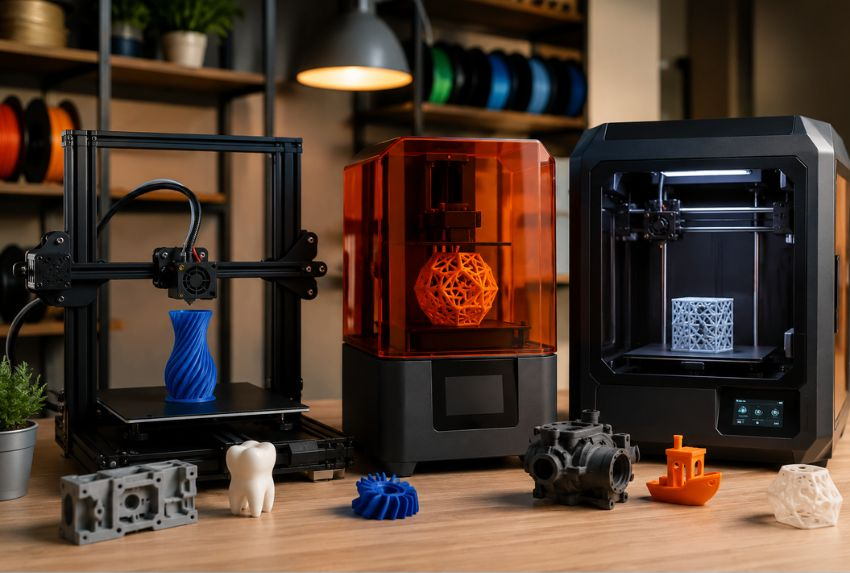
The desktop manufacturing landscape has matured significantly over the past decade. We have moved past the era where purchasing a desktop fabricator meant buying a box of loose aluminum extrusions and dedicating weekends to soldering wires, flashing firmware, and manually calibrating stepper motors. Today, modern machines are expected to operate as reliable workshop appliances. However, with the market flooded by aggressive marketing campaigns boasting astronomical print speeds and automated buzzwords, separating practical hardware advancements from pure marketing fluff is increasingly difficult.
When evaluating equipment today, the focus must shift from theoretical maximum speeds to the hardware features that directly impact long-term reliability, material versatility, and print yield. Purchasing the right hardware requires a strict alignment between the machine’s mechanical architecture and the physical objects you actually intend to manufacture.
How to Choose the Right Machine Based on Your Use Case
Before comparing price tags or speed ratings, you must define your manufacturing intent. Printing large, hollow cosplay armor requires an entirely different thermal and mechanical architecture than printing high-temperature, load-bearing mechanical gears. The following features represent the core hardware divisions that dictate real-world performance.
1. Motion Systems: Bed Slingers vs. CoreXY
The physical way a machine moves its toolhead determines its speed, precision, and physical footprint. There are currently two dominant mechanical architectures in the desktop market:
- Cartesian (Bed Slingers): In this classic design, the printhead moves along the X and Z axes, while the heavy heated build plate moves back and forth along the Y-axis. Because the machine must violently throw the mass of the build plate—and the printed object resting on it—back and forth, these machines are inherently limited in speed. Pushing them too fast results in “ghosting,” which appears as visible vibrations echoing across the surface of the print. They remain excellent, cost-effective options for large-format printing where speed is secondary to volume.
- CoreXY: This architecture is the standard for modern high-performance manufacturing. The build plate only moves slowly downward on the Z-axis, while the printhead is manipulated across the X and Y axes by a complex stationary belt system. Because the moving mass is isolated to the lightweight toolhead, CoreXY machines can print at significantly higher speeds without degrading surface quality or introducing layer shifts.
2. Extrusion Architecture and Thermal Limits
The toolhead is the beating heart of any 3D printer. If the extrusion system is weak or poorly designed, the entire machine is compromised. You must evaluate two specific components: the extruder gear system and the hotend thermal limit.
Older machines utilized Bowden tube setups, where the extruder motor sat on the frame and pushed plastic through a long PTFE tube into the hotend. This caused severe stringing and made printing flexible materials nearly impossible. Modern machines should feature a “Direct Drive” extruder, where the feeding gears sit directly above the melting zone. This provides immediate retraction control and allows for flawless extrusion of flexible polyurethanes and soft materials.
Furthermore, look for an all-metal hotend rated for at least 300°C. Standard hotends lined with PTFE tubing begin to degrade and off-gas toxic fumes above 240°C, artificially limiting the types of plastics you can use. A 300°C all-metal setup ensures you are not restricted by hardware limitations when moving beyond basic materials.
3. Enclosures and Material Capability
The physical structure around the machine dictates the chemistry it can handle. If your workflow relies heavily on engineering-grade filament—such as ABS, ASA, Polycarbonate, or Nylon—you cannot use an open-frame machine.
These high-performance plastics shrink rapidly when exposed to cool, ambient air currents. If printed on an open machine, the temperature differential between the heated bed and the room air will cause the plastic to warp violently, ripping the object off the build plate mid-print. To successfully print these materials, the machine must have a fully enclosed chamber. Passive enclosures trap the heat generated by the build bed to maintain a steady ambient temperature, while active enclosures use secondary heaters to precisely control the chamber environment, ensuring massive parts cool uniformly without internal stress fractures.
4. Automated Calibration: The End of Manual Leveling
For years, the most frustrating part of desktop fabrication was the “paper test”—manually twisting knobs under the bed to ensure the nozzle was exactly a paper-width away from the glass. This was highly subjective and led to countless failed first layers and damaged build surfaces.
A modern machine should not require human intervention for bed leveling. However, there is a distinct difference between “assisted leveling” and true automation.
- Inductive or Capacitive Probes: These sensors detect the metal of the build plate to map its curvature. They work well, but you still must manually calibrate the “Z-offset”—the exact physical distance between the probe trigger point and the tip of the nozzle.
- Load Cell Sensors: This is the current gold standard for consumer convenience. A load cell is a pressure sensor built directly into the toolhead. The machine physically taps the tip of the nozzle against the build plate to map the bed and calculate the exact Z-offset mechanically. It guarantees a flawless first layer every single time, regardless of what type of build surface is installed or how many times you swap nozzles.
Feature Alignment by Manufacturing Profile
To simplify the decision-making process, compare your primary manufacturing goal against the hardware requirements outlined in this matrix.
| Primary Use Case | Recommended Kinematics | Extrusion / Hotend | Chamber Requirement |
| Cosplay & Large Props (PLA/PETG) | Cartesian (Bed Slinger) | Direct Drive, 250°C | Open Frame |
| Functional Engineering Parts (ABS/Nylon) | CoreXY | All-Metal, 300°C+ | Fully Enclosed |
| Rapid Iteration / Prototyping (Mixed) | CoreXY | Direct Drive, 300°C | Enclosed |
| Miniatures & Extreme Detail | Resin (SLA/DLP Systems) | N/A | UV Cover / Ventilation |
Conclusion
Purchasing fabrication hardware should never be driven by the raw marketing claims printed on the side of the box. A machine claiming to hit extreme speeds is practically useless if it lacks the structural rigidity or the thermal consistency to keep the plastic adhered to the bed.
Evaluate your workflow objectively before investing. If you intend to print massive, decorative PLA helmets, investing in a high-temperature enclosed CoreXY system is an unnecessary expenditure; a large-format bed slinger will serve you perfectly. Conversely, if you need to manufacture heat-resistant mechanical gears from advanced polymers, an open-frame machine will fail every time, regardless of its speed. By focusing heavily on the motion system, the thermal limits, and the calibration hardware, you can select a tool that operates as a reliable manufacturing appliance rather than a continuous troubleshooting project.
