The number seven has long occupied a unique position in the human experience. Across diverse civilizations and epochs, it has been viewed not merely as a digit, but as a fundamental building block of reality. From the seven days of the creation narrative in the Bible to the seven celestial bodies that define the rhythm of Vedic astrology, this number appears to bridge the gap between the mundane and the divine. By examining how ancient cultures interpreted this recurring figure, we can uncover a shared architectural blueprint in how humanity has historically sought to understand its place within the cosmos.
The fascination with the number seven likely stems from its observable presence in the natural world. Ancient observers noted the seven visible celestial bodies moving against the backdrop of the fixed stars, a cycle that became the foundation for our seven-day week. Today, as we navigate the complexities of the modern world, many people continue to look for this same sense of structural clarity in their lives. For those seeking personal insight into these enduring patterns, platforms like Astroma.co offer a refined, modern gateway where users can engage in a free chat with astrologer to better understand how ancient time-keeping influences their own individual journey.
The Biblical Significance: A Symbol of Completion
In biblical literature, the number seven is synonymous with completeness and perfection. Its prominence begins in Genesis, where the creation process culminates on the seventh day—the Sabbath—marking the moment of rest and divine satisfaction.
This is not a singular instance. Throughout the scriptures, seven acts as a recurring motif for restoration and spiritual integrity. The walls of Jericho fell after seven days of circling; the menorah in the temple possessed seven lamps; and in the Book of Revelation, the number appears dozens of times to denote the fullness of time and divine order. For the biblical scholar, seven is the signature of a purposeful universe. It suggests that time is not a random series of events, but a structured progression leading toward a state of fulfillment.
The Vedic Perspective: The Seven Celestial Architects
While the biblical tradition views seven as a mark of divine completion, the Vedic systems of India treat it as a structural map of human experience. Vedic thought identifies the Saptarishi (the seven great sages) and correlates the seven major celestial bodies—the Sun, Moon, Mars, Mercury, Jupiter, Venus, and Saturn—with the internal and external forces that shape our karma.
In this tradition, the number seven is foundational to the concept of time. The movement of these seven bodies creates the cycles of experience that every individual traverses. These are not seen as rigid destinies, but as rhythmic seasons of life. Understanding these cycles is akin to reading the weather report of the soul; it allows one to prepare for challenges and capitalize on moments of growth.
Comparative Overview: Seven in Ancient Thought
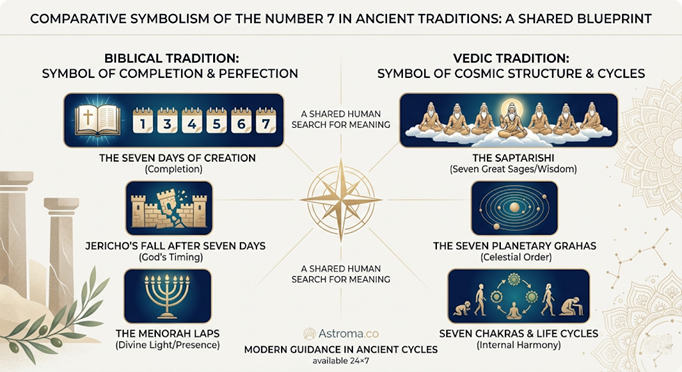
To visualize how these traditions align, it is helpful to contrast their core interpretations of this potent number:
| Aspect | Biblical Tradition | Vedic Tradition |
| Primary Meaning | Perfection and Completion | Cosmic Structure and Cycles |
| Core Symbolism | The Seven Days of Creation | The Seven Celestial Bodies |
| Human Application | Observance and Rest | Mapping Life’s Rhythms |
| Nature of Time | Linear, moving toward fulfillment | Cyclical, moving through stages |
Bridging Ancient Wisdom and Modern Intuition
The reason the number seven continues to captivate us lies in our innate desire for order. Whether one approaches this through the lens of theology or the mathematical rigor of ancient astrology, the result is the same: the realization that our lives are connected to larger, predictable cycles.
Ancient civilizations understood what we often forget: that we are part of a grander design. When we examine the “Divine Architecture,” we see that the ancients did not view science and spirituality as separate entities. The movement of the stars was their science, and the meaning derived from those movements was their spirituality. By studying these traditions, we gain more than just historical facts; we gain a perspective that helps us navigate modern uncertainty.
Understanding Cycles of Time
Much like the biblical concept of “a time for everything,” Vedic thought emphasizes that our lives are governed by various Dasha periods—time cycles dictated by the planets. Just as a garden has seasons for planting, blooming, and dormant rest, human life experiences corresponding shifts.
Recognizing these transitions is the first step toward living with intention. When we understand the patterns—the “sevens” in our own lives—we move from a state of reactive stress to one of proactive wisdom. It is a transition from merely living through time to actually understanding the flow of our personal evolution.
Frequently Asked Questions (FAQ)
Q.1 : Why is the number seven considered so significant across different cultures?
Ans: The significance of seven is largely attributed to its relationship with the natural world, specifically the seven celestial bodies visible to the naked eye. This created a universal standard for time-keeping and spiritual reflection that transcended geographic boundaries.
Q.2: How can I apply these ancient concepts to my daily life?
Ans: By recognizing that life moves in cycles rather than a straight line, you can better manage expectations. Periods of difficulty are often viewed in these traditions as necessary “winnowing” phases, while periods of success are seen as times to harvest the fruits of your efforts.
Q.3: Is the study of celestial patterns scientific?
Ans: In the ancient world, astronomy and astrology were integrated. While modern science distinguishes between them, many people still find value in the philosophical and archetypal frameworks provided by ancient systems to gain personal clarity and peace of mind.
Q.4: What is the connection between biblical numerology and Vedic astrology?
Ans: While they originate from different cultural foundations, both systems share a fundamental belief that the universe is ordered and that numerical and celestial patterns act as a language for the divine, reflecting the interconnectedness of all things.
