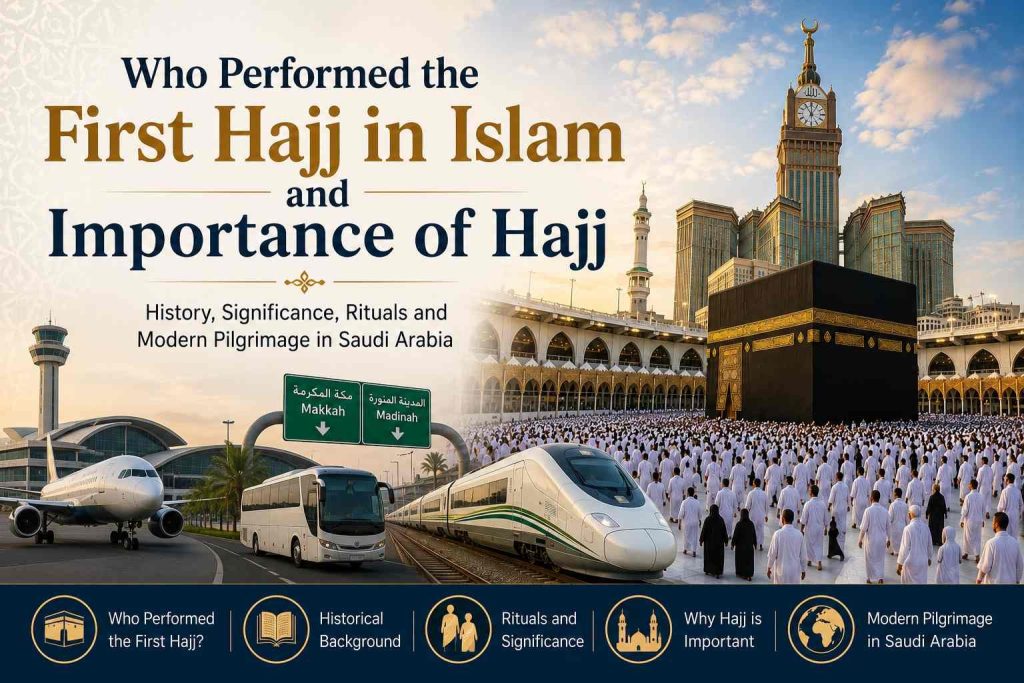
Hajj is one of the greatest acts of worship in Islam and one of the five pillars upon which the religion is built. Every year, millions of Muslims travel to Makkah in Saudi Arabia to perform this sacred pilgrimage and follow in the footsteps of the prophets.
Many Muslims often ask an important historical question: Who performed the first Hajj in Islam?
The answer requires understanding both the history of Prophet Ibrahim and the final teachings of Prophet Muhammad. The story of Hajj goes back thousands of years and is deeply connected to faith, sacrifice, unity, and obedience to Allah.
Today, Hajj is also one of the largest annual gatherings in the world. Pilgrims travel by air, road, rail, and sea to reach the holy cities of Makkah and Madinah.
Modern transportation systems and reliable travel partners in Saudi Arabia, such as VIP Umrah Taxi, have made it much easier for pilgrims to travel comfortably between airports, hotels, and the holy cities of Makkah and Madinah during Hajj and Umrah.
What Is Hajj in Islam?
Hajj is the annual Islamic pilgrimage to the Kaaba located inside Masjid al-Haram. It is obligatory once in a lifetime for every Muslim who is physically and financially able to perform it.
Hajj takes place during the Islamic month of Dhul Hijjah and includes a series of rituals performed over several days in Makkah and nearby holy sites.
The pilgrimage represents complete submission to Allah and reminds Muslims of the sacrifices made by Prophet Ibrahim, his wife Hajar, and their son Prophet Ismail.
Hajj = Faith + Sacrifice + Obedience to Allah
Allah says in the Quran:
“And proclaim to the people the Hajj pilgrimage. They will come to you on foot and on every lean camel from every distant path.”
Surah Al-Hajj 22:27
This verse beautifully describes how people would travel from distant lands to answer the call of Allah. Today, Muslims still respond to that same call, although modern transportation has transformed the journey through international flights, high speed trains, buses, and private pilgrimage transport services.
Who Performed the First Hajj in Islam?
The answer depends on the historical context being discussed.
Prophet Ibrahim and the Origins of Hajj
According to Islamic tradition, the origins of Hajj began with Prophet Ibrahim AS. Allah commanded him to build the Kaaba with his son Prophet Ismail AS in Makkah.
After building the Kaaba, Prophet Ibrahim AS was commanded by Allah to invite humanity to pilgrimage. This became the foundation of Hajj.
Muslims believe many rituals of Hajj originated from the lives of Prophet Ibrahim, Hajar, and Ismail, including:
- Tawaf around the Kaaba
- Sa’i between Safa and Marwa
- Sacrifice during Eid al Adha
- The spiritual significance of Mina and Arafat
For this reason, Prophet Ibrahim AS is considered the first person connected to the establishment of Hajj.
The First Official Hajj in Islam
Although the roots of Hajj go back to Prophet Ibrahim AS, the first official Hajj in Islam as practiced by Muslims today was performed by Prophet Muhammad (PBUH).
After the conquest of Makkah, Prophet Muhammad (PBUH) purified the Kaaba by removing idols and restoring the worship of one God.
In the 9th year after Hijrah, Abu Bakr led the Muslims in Hajj under the instruction of Prophet Muhammad (PBUH). During this pilgrimage, important declarations were made that ended pagan rituals associated with the Kaaba.
Then, in the 10th Hijri year, Prophet Muhammad (PBUH) personally performed Hajj with over one hundred thousand companions. This pilgrimage became known as the Farewell Pilgrimage or Hajjatul Wida. During this Hajj, the Prophet (PBUH) taught Muslims the proper rituals that continue to be followed today.
Therefore:
- Prophet Ibrahim AS established the foundations of Hajj
- Prophet Muhammad (PBUH) performed the first complete Islamic Hajj in its final and purified form
The Story of Hajar and the Beginning of Sa’i
One of the most emotional parts of Hajj is the Sa’i between the hills of Safa and Marwa.
This ritual commemorates the struggle of Hajar, the wife of Prophet Ibrahim AS. When left in the desert of Makkah with her infant son Ismail, she desperately searched for water and ran seven times between Safa and Marwa.
Allah answered her prayers with the miracle of Zamzam water, which still flows today near the Kaaba.
Every year, millions of pilgrims repeat this act during Hajj and Umrah to remember her faith, patience, and trust in Allah.
How Prophet Muhammad (PBUH) Restored Hajj
Before Islam, pagan Arab tribes had changed many traditions of Hajj. Idolatry spread around the Kaaba, and some rituals were performed incorrectly.
When Prophet Muhammad (PBUH) conquered Makkah, he restored the Kaaba to pure monotheistic worship.
During his Farewell Pilgrimage, he explained every major ritual of Hajj, including:
- Ihram
- Tawaf
- Sa’i
- Standing at Arafat
- Staying in Muzdalifah
- Rami at Mina
- Qurbani sacrifice
His Farewell Sermon during Hajj also emphasized equality, justice, mercy, and unity among Muslims.
Today, pilgrims continue performing Hajj according to the Sunnah of Prophet Muhammad (PBUH).
Why Is Hajj Important in Islam?
Hajj holds enormous spiritual importance for Muslims around the world.
1. Hajj Is a Pillar of Islam
Hajj is one of the five pillars of Islam. Every capable Muslim is required to perform it once in their lifetime. It represents obedience to Allah and dedication to faith.
2. Hajj Strengthens Faith
The pilgrimage removes Muslims from worldly distractions and focuses their hearts entirely on worship. Pilgrims spend days praying, remembering Allah, and reflecting on their lives. Many Muslims describe Hajj as the most transformative spiritual experience of their lives.
3. Hajj Teaches Equality
During Hajj, all pilgrims wear simple clothing called Ihram. Rich and poor stand side by side without distinction of race, nationality, language, or social status. This powerful image reflects the unity of the global Muslim Ummah.
4. Hajj Reminds Muslims of the Day of Judgment
The gathering of millions of people on the plains of Mount Arafat reminds Muslims of the Day of Resurrection. Pilgrims stand in prayer asking Allah for forgiveness and mercy.
The Day of Arafah is considered one of the holiest days in Islam.
5. Hajj Offers Forgiveness of Sins
Prophet Muhammad (PBUH) said:
“Whoever performs Hajj and does not commit any obscenity or wrongdoing will return as pure as the day his mother gave birth to him.”
This hadith highlights the spiritual purification associated with Hajj.
Main Rituals of Hajj
Hajj includes several important rituals performed across different holy sites in Saudi Arabia.
- Ihram: Pilgrims enter a sacred state of purity and intention before beginning Hajj.
- Tawaf: Pilgrims walk seven times around the Kaaba.
- Sa’i: Walking between Safa and Marwa in remembrance of Hajar.
- Mina: Pilgrims stay in Mina during specific days of Hajj.
- Arafat: Standing in prayer and supplication at Arafat is the most important ritual of Hajj.
- Muzdalifah: Pilgrims spend the night under the open sky and collect pebbles.
- Rami: Pilgrims stone symbolic pillars representing Satan.
- Qurbani: Animal sacrifice commemorates Prophet Ibrahim’s obedience to Allah.
Hajj in Modern Saudi Arabia
Modern Hajj is one of the largest logistical and transportation operations in the world. Every year, millions of pilgrims arrive in Saudi Arabia through:
- International airports
- High speed rail networks
- Intercity buses
- Private transportation services
Many pilgrims first arrive in Jeddah before traveling to Makkah and Madinah. Saudi Arabia has invested heavily in pilgrimage infrastructure to improve the experience of Hajj and Umrah visitors.
One major transportation development is the Haramain High Speed Railway, which connects Makkah, Madinah, Jeddah, and King Abdulaziz International Airport.
Modern transport services now help pilgrims:
- Travel safely between holy cities
- Reduce travel time
- Avoid overcrowding
- Focus more comfortably on worship
Reliable transportation is especially important for elderly pilgrims, families, and international visitors unfamiliar with local routes.
The Evolution of Hajj Travel
The journey of Hajj has changed dramatically over history. Centuries ago, pilgrims traveled for months through deserts using camel caravans and trade routes.
Pilgrims faced:
- Extreme weather
- Lack of water
- Bandit attacks
- Long travel distances
- Difficult desert conditions
Today, pilgrims can reach Saudi Arabia within hours using modern air travel and organized transport systems. Despite these advancements, the spiritual essence of Hajj remains unchanged.
Muslims still travel from every distant land to answer the call first proclaimed by Prophet Ibrahim AS thousands of years ago.
Difference Between Hajj and Umrah
Both Hajj and Umrah are sacred pilgrimages, but there are important differences.
Hajj
- Obligatory once in a lifetime
- Performed only during Dhul Hijjah
- Includes specific rituals over several days
Umrah
- Voluntary pilgrimage
- Can be performed any time of the year
- Shorter and simpler than Hajj
Millions of Muslims also travel to Saudi Arabia throughout the year for Umrah, creating continuous demand for organized pilgrimage transportation and travel services.
Conclusion
The story of Hajj begins with Prophet Ibrahim AS and reaches its complete form through Prophet Muhammad (PBUH). From the construction of the Kaaba to the Farewell Pilgrimage, Hajj represents devotion, sacrifice, unity, and submission to Allah.
Today, millions of Muslims continue this sacred journey to Makkah every year, following the footsteps of the prophets and fulfilling one of the greatest obligations in Islam.
Modern Saudi Arabia has transformed the pilgrimage experience through advanced infrastructure, transportation networks, and pilgrim services that help worshippers travel more safely and comfortably between the holy cities.
Although methods of travel have evolved from camel caravans to high speed trains and international flights, the spiritual purpose of Hajj remains timeless. It continues to unite Muslims from all backgrounds in one of the most profound acts of worship in the world.
