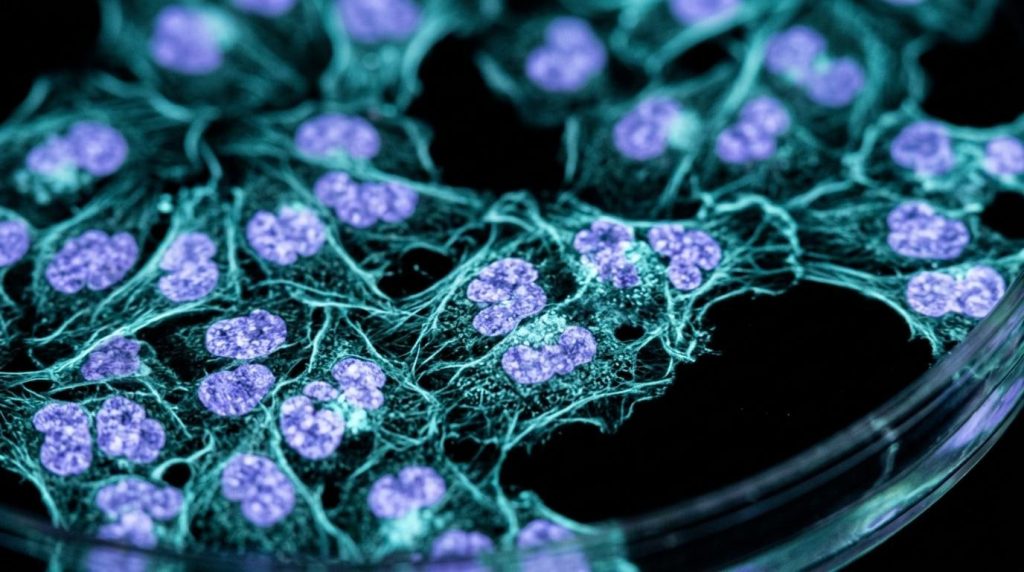
Few cell lines in cancer biology have proven as resilient — or as useful — as the A549. More than five decades after it was first cultured, it continues to anchor studies ranging from basic tumour biology to the validation of next-generation therapeutics. Understanding why it has lasted this long means looking closely at what makes it uniquely suited to the work researchers need to do.
A Line With Deep Roots
The story begins in 1972, when D. J. Giard and colleagues at the National Cancer Institute established the A549 line as part of a systematic effort to derive continuous cell lines from solid human tumours. The source tissue came from the lung adenocarcinoma of a 58-year-old Caucasian male, and the resulting line was propagated as adherent, epithelial-like cells that grew as stable monolayers. That founding moment was part of a broader push to create renewable, in-vitro resources for cancer science — and A549 turned out to be one of the most enduring outcomes of that effort.
What kept the line relevant was not just its origin. It retained key biological features of the parent tissue: alveolar Type II pneumocyte characteristics, the capacity to synthesise lecithin and surfactant-associated proteins, and a hypotriploid chromosome count with a modal number of 66. These are not trivial details. They mean the cells behave, to a useful degree, like the tissue they are meant to model.
The Genetic Profile That Makes It Indispensable
A549 cells carry a mutated KRAS oncogene — specifically the G12S variant — alongside wild-type TP53. This combination is clinically significant. KRAS mutations are among the most common driver mutations in non-small cell lung cancer (NSCLC), and they remain notoriously difficult to target therapeutically. The line also harbours KEAP1/NRF2 pathway mutations, which enhance oxidative stress resistance and contribute to chemoresistance phenotypes that mirror what clinicians see in patients.
For researchers investigating RAS-driven signalling, drug resistance mechanisms, or the biology of NSCLC — which accounts for approximately 85–88% of all lung cancer cases — this genetic landscape is not a quirk, it is a feature. The cell line effectively encodes the problem that oncology is trying to solve.
Applications Across the Research Pipeline
The breadth of A549 applications is one reason it remains a default choice in so many laboratories. A549 Cells have been used across the full spectrum of preclinical work, from high-throughput drug screening to in-vivo xenograft modelling, and the range continues to expand.
In drug development specifically, the line has served as a testing platform for compounds including paclitaxel, docetaxel, and bevacizumab — both in standard cell culture and in xenograft mouse models, where A549 cells injected subcutaneously into nude mice grow to form human lung tumours that allow controlled evaluation of therapeutic efficacy. Beyond oncology, A549 cells are widely used in toxicology to assess how environmental pollutants and chemical agents affect pulmonary epithelium, making them a relevant tool for regulatory and safety research as well.
More recently, the line has found a role in gene therapy and vaccine development. Because A549 cells can support adenovirus production without the E1A oncogene, they offer a controlled system for studying adenoviral gene expression — an increasingly important consideration as adenoviral vectors feature more prominently in clinical-stage programmes.
Practical Strengths That Sustain Its Use
Beyond biological relevance, A549 cells have practical characteristics that keep them popular in busy research settings:
- A doubling time of approximately 24 hours, which supports rapid experimental cycles.
- Robust adherent growth as monolayers, making them straightforward to culture and passage.
- Consistent availability through established biobanks and commercial suppliers.
- A well-documented literature base, meaning new findings can be benchmarked against decades of prior work.
Reproducibility matters enormously in translational research, and the depth of existing A549 data reduces experimental uncertainty in a way that newer, less-characterised lines simply cannot match.
Knowing the Limitations
A balanced assessment has to acknowledge what A549 cells cannot do. They represent a single adenocarcinoma subtype, so they do not capture the full heterogeneity of lung cancer histology. Their chromosomal instability means long-term culture requires careful monitoring to avoid phenotypic drift. And while they model certain ATII pneumocyte features, more recent studies have taken a cautious view of how completely they recapitulate that primary cell phenotype.
None of this makes A549 cells a poor choice. It makes them a specific tool — one that excels in particular contexts and should be paired with complementary models when broader coverage is required. Used with that awareness, they remain one of the most informative platforms available.
What Researchers Should Keep in Mind
If you are working with A549 cells, source quality and passage history matter more than many protocols acknowledge. Confirm KRAS mutational status at the start of any study where RAS signalling is central to your hypothesis. Monitor passage number closely — phenotypic changes accumulate over extended culture, and high-passage cells may not reproduce published results reliably. Where possible, validate key findings in at least one additional NSCLC model to ensure the biology you are seeing is not specific to this particular genetic background. The A549 line rewards careful handling; treat it as the precision instrument it is rather than a generic workhorse, and it will continue to deliver the quality of data that has kept it central to lung cancer research for over fifty years.
