There is a moment, in the right room, when you stop noticing the walls and start feeling them.
The furniture fades. The clutter of the day falls away. And what remains is a quality of atmosphere — something warm, unhurried, and quietly alive — that you cannot quite explain but immediately recognize. You have been in rooms like this before. You remember how they made you feel.
More often than not, a painting made it possible.
The Art of Creating a Sacred Bedroom Space
The bedroom occupies a unique position in the architecture of a human life. It is the room we return to at the end of every day — stripped of our public roles, our professional masks, our social performances. It is where we are most honestly ourselves. And it is where, for many people, the most genuine moments of prayer, reflection, and spiritual contact occur.
Yet most of us decorate our bedrooms almost as an afterthought. We choose what matches, what fills the space, what looks acceptable. Rarely do we ask the deeper question: what do I want to feel in this room? And rarer still: what do I want to remember here?
Choosing bedroom paintings with genuine intention — with beauty, meaning, and spiritual depth as the guiding criteria — is one of the most quietly transformative things you can do for your inner life. It costs no more than any other purchase. It requires no special knowledge or expertise. It asks only that you slow down enough to look, and to feel, before you decide.
Beauty: The First Language of Sacred Art
Beauty is not superficial. In every major spiritual tradition, beauty has been understood as a doorway — a sensory experience that, when genuine, points beyond itself toward something larger and less nameable.
This is why the great sacred art of history was made with such extraordinary care. The medieval icon painters fasted and prayed before beginning work. The artists of the Renaissance studied anatomy, light, and geometry for decades before attempting a devotional canvas. The Japanese masters of ink painting trained for years to achieve the effortless simplicity of a single brushstroke.
They understood that beauty, in sacred art, is not ornament. It is message. A painting made with genuine skill and care carries that care into the room it enters. You feel it before you can articulate it — in the quality of the light depicted, in the weight of the shadows, in the way the composition leads your eye not outward but inward.
When choosing bedroom paintings for a sacred space, ask first: is this beautiful in a way that will sustain repeated viewing? Beauty that exhausts itself quickly — the immediately striking but ultimately shallow — will not serve a contemplative space. What you need is the kind of beauty that deepens with familiarity. That gives you something new each time you look.
Meaning: Art That Carries More Than Its Subject
A painting can depict a flower and mean nothing. It can depict the same flower and mean everything. The difference lies not in the subject but in what the painter brought to the canvas — the intention, the attention, the inner life behind the work.
Meaningful art resonates. It touches something in you that you recognize but cannot always name. It seems to know something about you, about the human condition, about the particular quality of longing or gratitude or grief that you carry on a given morning. And it meets you there — not with answers, but with presence.
For a sacred bedroom space, meaning comes in many forms.
It can be devotional — a painting that depicts a figure, a moment, or a gesture from a spiritual tradition that is personally significant to you. There is a reason that images of the Buddha have been placed in meditation spaces for two and a half millennia. The figure carries meaning accumulated across centuries of practice and contemplation — meaning that does not diminish with time but deepens.
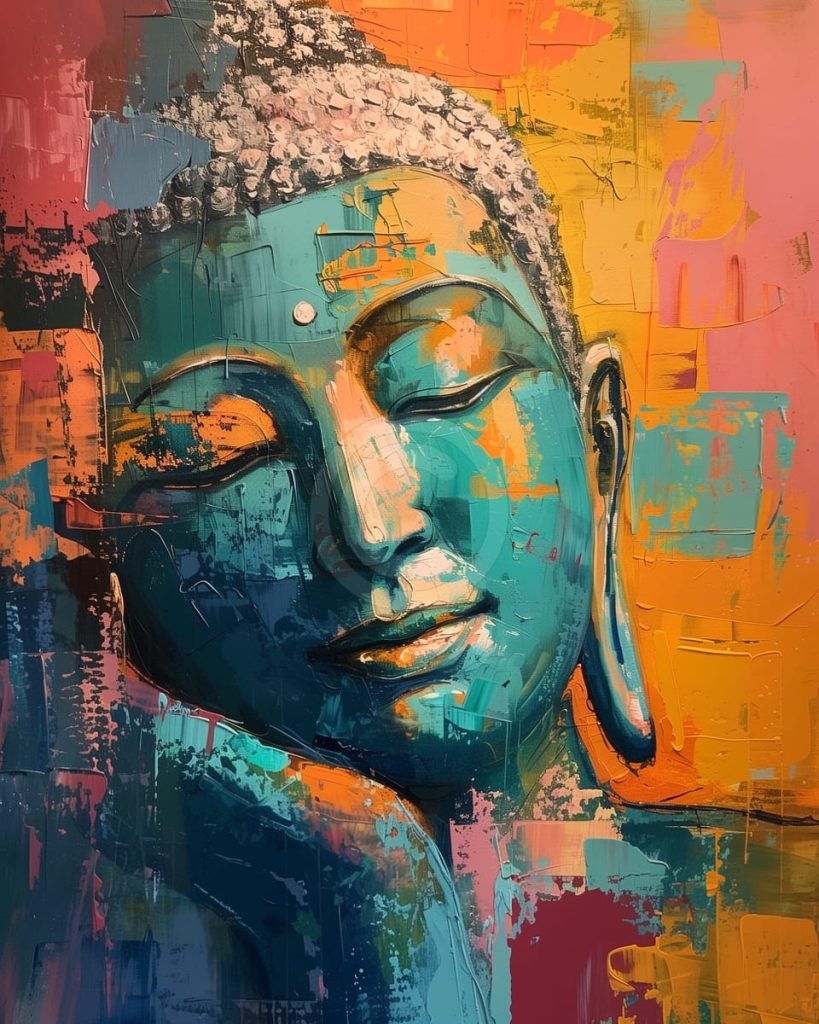
Buddha Portrait is a handmade original canvas painting that brings this quality of presence into a bedroom with quiet authority. The portrait does not shout. It does not perform. It simply holds — with the particular stillness that the best devotional art achieves — a quality of peace that is available to anyone who pauses long enough to receive it. Hung in a bedroom, above a small prayer corner or simply on the wall your eyes find first in the morning, it becomes more than decoration. It becomes a daily reminder of what stillness feels like, and what it is for.
Meaning can also be elemental — a landscape that evokes the vastness of sky, the patience of water, the endurance of stone. Nature has always served as a sacred text, and a painting that captures a genuine quality of natural presence can carry the same contemplative weight as any explicitly devotional image.
Or meaning can be personal — a painting that speaks to your particular history, your particular grief, your particular hope. Sacred art is not one-size-fits-all. What opens one person’s heart may leave another unmoved. Trust your own response. The painting that makes you catch your breath, that makes you stand still for a moment longer than you intended, is the one that carries meaning for you.
Spiritual Depth: The Quality That Cannot Be Manufactured
Beauty can be studied. Meaning can be cultivated. But spiritual depth — that quality in a painting that makes you feel, inexplicably, as though something in it is looking back — cannot be manufactured. It is either there or it is not.
It tends to be present in original work made by artists who themselves have an inner life. Not necessarily artists who follow a particular religion or tradition, but artists who have paid attention — who have sat with the difficult questions, who have allowed their own experience of mystery and mortality and gratitude and longing to find its way into the work.
This is one of the most important reasons to choose original handmade paintings over printed reproductions for a sacred bedroom space. A reproduction is a copy of an image. An original canvas is the image itself — the surface on which a human being stood and worked and thought and felt. The brushstrokes carry that history in a way that no print can replicate. The texture of the paint, the slight irregularities of a hand-applied surface, the weight of the canvas — these are not imperfections. They are the evidence of presence. And presence, in a sacred space, matters enormously.
Practical Guidance: Placing Sacred Bedroom Paintings With Intention
Once you have found a painting that meets all three criteria — beauty, meaning, and spiritual depth — the question of placement deserves equal care.
Eye level from rest. The most powerful position for a sacred bedroom painting is at eye level when you are sitting or lying on the bed — the position you occupy in your quietest moments. You want the painting to be there when your guard is down, when your attention is soft and receptive, not when you are rushing past it on your way to the wardrobe.
Uncluttered surroundings. A sacred painting needs breathing room. Resist the urge to surround it with other objects, other images, other visual demands. Let it stand alone, or nearly so. A small candle nearby, a simple plant, a meaningful object on a shelf beneath — these can frame a sacred space without competing with it.
Consistent light. Natural morning light is ideal for a devotional painting, if your room receives it. Warm artificial light — from a lamp positioned slightly to the side — is a good alternative. Avoid harsh overhead lighting, which flattens the texture of a canvas and strips it of the quiet atmosphere that makes it work in a contemplative setting.
A practice of looking. This sounds obvious but is easily forgotten. The painting will only become part of your spiritual life if you actually look at it — deliberately, attentively, regularly. Even thirty seconds of genuine attention each morning, before you reach for your phone or begin the machinery of the day, is enough to shift something. The painting becomes an anchor. And over time, anchors hold.
Exploring Original Bedroom Paintings
For those ready to begin — or to deepen — this practice of surrounding themselves with meaningful art, the starting point is finding work that genuinely speaks to you.
PastelBrush’s bedroom paintings brings together a curated selection of original handmade canvas paintings suited to personal and contemplative spaces — devotional portraits, quiet landscapes, softly spiritual abstracts, and intimate figurative works. Every piece is painted by hand. Every canvas is an original. Browsing the collection is itself an exercise in the kind of slow, attentive looking that a sacred space practice is built upon.
There is no formula for finding the right painting. You will know it when you see it — when something in you stills unexpectedly, when your eye keeps returning to the same image, when you find yourself thinking about it after you have closed the page. That response is not arbitrary. It is the beginning of a relationship between you and a work of art — a relationship that, placed at the threshold of each new day, can quietly change the quality of everything that follows.
Final Thoughts
A sacred bedroom space does not require much. A corner. A candle. A few moments of genuine stillness. And a painting — one painting — chosen not for what it matches but for what it means. For the beauty it carries. For the depth it holds.
The rooms that feel truly at peace are not decorated. They are curated — slowly, intentionally, with care for the inner life of the person who inhabits them. They are rooms that say, without words: here, you are allowed to be still. Here, something is being held for you.
A single painting can say all of that. The right one will say it every morning, for the rest of your life.
